Mondeto
  • Home
  • Talking to the Whole Wide World
  • Yay Sayers
  • Bookshop
  • Blogs
  • Asia Literacy
  • ABC Interview
  • Professor Joseph Lo Bianco
  • Professor Michael Clyne
  • Professor Alan J Bishop
  • Dr Phillip Mahnken
  • Dr Peter Ellyard
  • Esperanto Online
  • Esperanto, a Western Language?
  • Montessori LOTE
  • East Bali Poverty Project
  • Contact Us
Immediate and Lasting Advantages of Early Esperanto: 1. Brain Building 09/28/2011
4 Comments
 
Picture

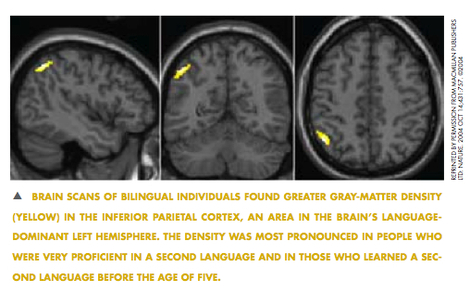
“New research into the neurobiology of bilingualism has found that being fluent in two languages, particularly from early childhood, not only enhances a person’s ability to concentrate, but might also protect against the onset of dementia and other age-related cognitive decline.
Scientists have discovered that bilingual adults have denser gray matter (brain tissue packed with information-processing nerve cells and fibers), especially in the brain’s left hemisphere, where most language and communication skills are controlled. The effect is strongest in people who learned a second language before the age of five and in those who are most proficient at their second language. This finding suggests that being bilingual from an early age significantly alters the brain’s structure.” (Society for Neuroscience, 2008)
That's a long quote but it does say quite compactly what other sources confirm - that  learning another language, early and well, improves brain structure and function permanently, in a way that learning other things may not. Surely enhancing the ability to concentrate is something which will have benefits in every area of learning. Rather than being a distraction from "Key Competencies", "Basics" or "Core Subjects", early bilingualism can be seen as "sharpening the axe" before spending the day chopping down a really big tree!

Picture
Of course, it doesn't help to be vague about the practicalites of providing early bilingualism.
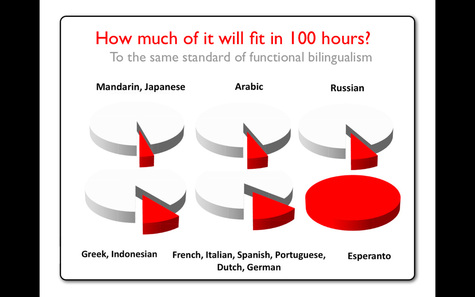
This chart shows what can be achieved in the first 100 hours of  education, using different target languages.*
As you can see, the benefits of bilingualism - improved concentration and resistance to dementia in later life - are fully realized by schools offering 100 hours of Esperanto, but not by the other choices.
After the first hundred hours, the choice is wide open again - more so than it was, but that's tomorrow's post!

*The figures are derived from a number of sources including Alex McAndrew, former director of Sydney University's language learning unit, and the US department of defense. They are for motivated adults, and children take a little longer (wonder why? ask me in the comments below!)


Comments

Sinjoro ENG
12/14/2011 04:15

Saluton.

It is a very wonderful article. But there is no comparison of learning English with 100 hours. Though people know the major language in Australia is English, many still do not know how much for English for 100 hours of learning,especially those live outside the English speaking countries.

I would appreciate the new picture of that so that it is easier for me to promote Esperanto in my country, Malaysia.

Thanks for the article.

Regards

Reply
Penny Vos link
12/14/2011 12:33

Saluton Sinjoro Eng,

Thanks for your comment :-)
The pie charts show how long various languages take for monolingual English-speakers to learn.

How long English takes to learn as a second language depends on what the first language is.

As a rough guide, you could assume that the linguistic distance is the same in either direction so that the graphs give an indication of how much English can learned in 100 hours, by speakers of the other languages.

If your first language is Mandarin, I would expect that English would take over 2000 hours to learn to the basic working level shown in these graphs.

Unfortunately, I don't think that learning Esperanto first will reduce English-learning time to as little as 100 hours, because Esperanto is quick to learn by design, not just by a symmetrical similarity to English.

Researchers at Asian University in Bangkok may soon have more to tell us about how much Esperanto helps Thai children to learn English.

Best regards,
Penny

Reply
Keith Bowes link
12/15/2011 20:02

I've read that an English speaker can learn Esperanto in one year, a Chinese speaker can learn Esperanto in two years, and a Chinese speaker can learn English in ten years. I'd assume that part of the extra time it takes for a Chinese speaker to learn Esperanto is related to the alphabet, which wouldn't plague a speaker of Malay (which AFAIK uses the Latin alphabet, same as Esperanto).

Reply
Sinjoro ENG link
12/17/2011 04:14

Saluton

Thanks for the info.

Here would like to share with the readers that the Chinese speakers now do not have problems with the Latin alphabet a,b,c etc because the Chinese mainland had changed the pronunciation symbols from zhuyin ( 注音) to hanyu pinyin (汉语拼音). The hanyu pinyin is using the a,b,c etc.

It is the Taiwanese have to learn the a, bo, co and of course the Tamil users in my country or Thai language users etc that they have to learn the a, bo, co ktp.

Even learning this simple a.bo,co. I think it would take more than one month, perhaps, not more than 20 hours.

Good luck to the Esperanto users and hope that more research would surface. I am still keeping my fingers crossed on the research of Esperanto could help the autism kids learn better. It was reported by the ex Chicogo Esperanto Association President Tony in the change dot com.

Regards

SE

Reply


Leave a Reply

    Author

    Penny Vos

    See also: Childhood Blog 
    and Global Blog :-)

    Archives

    December 2011
    November 2011
    October 2011
    September 2011
    June 2011
    February 2011
    January 2011
    December 2010
    November 2010
    October 2010
    September 2010
    August 2010
    July 2010

    Categories

    All
    Esperanto
    Learning
    Popi
    Video

    RSS Feed

    Translate
    015