Apprenticeship Language Learning? Language Apprenticeship?
|
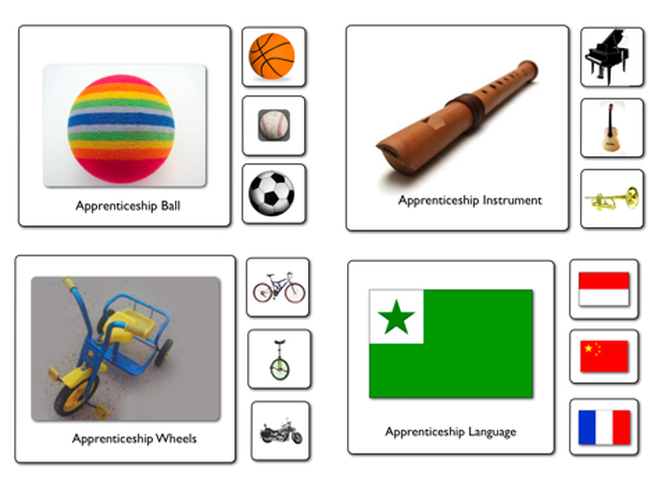
Language Apprenticeship and Apprenticeship Language Learning may not be familiar expressions, but the effective strategy they describe is familiar to anyone with experience of childhood education. Whatever we would like children to master in future: writing, team sports, music, cycling, reading, mathematics, science... we start them with an easy one, whether in a home setting or a kindergarten or a school. Mastery of that easy rhyme or song, or dance, or ball game is fun and provides information, physical capacity and enthusiasm for a harder one next time. Our own native tongue is an exception, of course, but a second language learnt at school is not.
First and second languages are usually learnt under very different conditions.
The simplest language we can offer is Esperanto. (How much simpler? and why?) Professor Joseph Lo Bianco, author of Australia's language policy, recommends Language Apprenticeship for all Australian children. Other experts explain their support here. Professor Renato Corsetti of the University of Rome, has summarized some of the studies of language apprenticeship to date. The graph to the right shows the results of one of those studies, which showed that Esperanto first saves time even when the eventual target language is as unrelated as Japanese. |
A first language at home and a second one at school are very different propositions. A study from Ohio University in 2019 calculated that a 5 year old child will have heard 4,662 words if never read to, and 1,483,300 words if read 5 books a day.
Except for immersion classes, school programs just don't have enough time to match even the poorest level of input, let alone having the kind of intrinsic motivation that a baby has to communicate its basic needs and wants with parents and siblings. So. if we are to succeed in languages education, we have to use the same good sense that leads us to use T-ball and rounders, physical mathematics materials, big, soft play balls, and simple instruments first. E 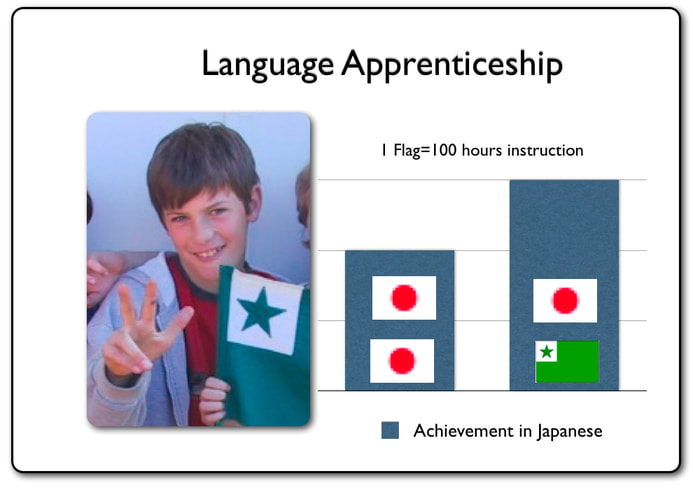
|


011