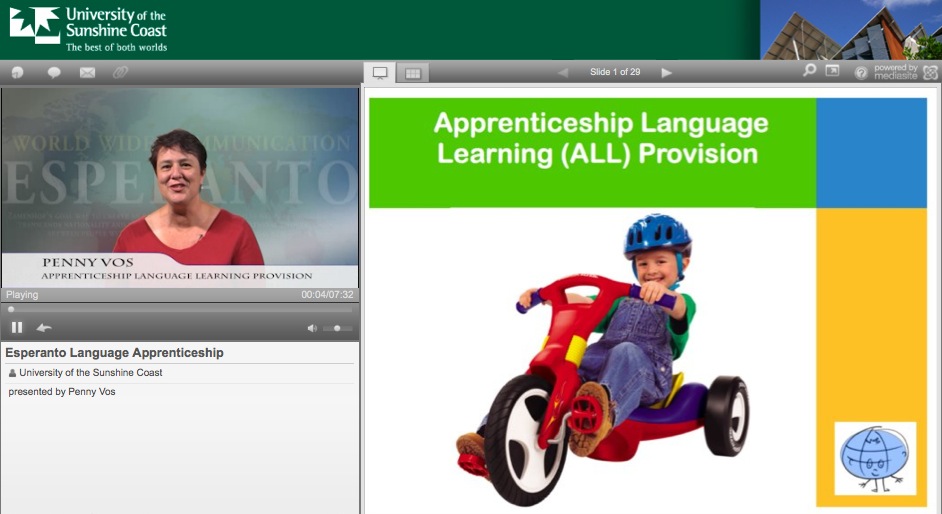
The University of the Sunshine Coast looks likely to be the first University in Australia to prepare Primary Education graduates to teach in all 8 key learning areas. Click the image above to watch the 7 minute introductory video, or read the transcript below.

Welcome! We’re glad to invite you to our innovative, brand new course in Apprenticeship Language Learning Provision. This strategy was recommended by Professor Joseph Lo Bianco (the author of Australia’s Language Policy) in the ACER review of 2009. The resources to implement it have been developed since the,n and the course to induct teachers in the use of the materials is finally ready!

As you know, primary education is about preserving and developing all of the different kinds of positive potential that all children have.
To make sure that we don’t forget anything, we identify 8 key learning areas....

.... and then every university in Australia equips primary teachers to teach 7 of them!
We can’t possibly know which language or languages will matter for each Australian child, but we do know that the capacity to be fluently multilingual is as much a part of normal babies as is their capacity to be artistic, athletic, mathematical, musical and more.
It is the job of primary education to keep children’s options open in all learning areas, until they are old enough to choose to specialize.

So our university is raising the bar by delivering a new course which will equip our students with the linguistic understandings and methodology to provide children with a fluent intercultural apprenticeship language in the first 100 hours or so of instruction.

The only language simple enough to learn in a 2-week intensive course and 100 hours  of teaching your class, is Esperanto because, uniquely, it was designed for quick learning and worldwide communication.

Four cognitive advantages for your students, when you complete and apply this course are: enhanced ability to concentrate, accelerated learning of target languages, enhanced understanding of formal English and exercising higher order thinking skills.

Neuroscience now tells us that bilingual brains are structurally better equipped to screen out distractions and concentrate. It doesn’t matter what the languages are, but it does matter that they are quite fully mastered, in childhood.

Early mastery of Esperanto accelerates the learning of subsequent languages, by giving an overview of how languages generally work, how to learn them, and increased confidence and motivation. This advantage has been shown to be stronger than the benefit of spending 100 more hours on the target language!

a. Learning any language assists understanding of formal English, but Esperanto is especially supportive as it has “transparent” grammar.
This means that nouns, adjectives, adverbs, pronouns and six varieties of verbs, are all easily recognizable by the last letters. As one child said recently, “I know if a word is an adjective by whether it ends with an “a” in Esperanto”.
To give you an idea of the sound of Esperanto, I’ll read these words aloud: blua, ruĝa, alta, vasta, granda, malgranda, hundo, kato, fiŝo, bovo, birdo, tablo, domo, dancas, kantas, amas, manĝas, dormas

a. It might seem surprising that a solution offering simplicity should also claim to foster an unusually a high degree of high order thinking, but teaching Esperanto first does.
 High order thinking skills need practice to become habitual and the lack of idiosyncratic bits and pieces like “i before e except after c except if it’s weird or.... leaves more time to practice understanding, application, analysis, evaluation and creativity.

b. The green diagram is taken straight from Wikipedia and reflects Bloom’s idea about how higher order thinking builds on the basics, broadening to embrace several equally vital skills at the final stage. The reddish one is distorted to show how the vast amount of memorizing required in most language learning restricts the time available to practice the higher levels of  thinking. By using Esperanto as the first foreign language, we can give our youngest children opportunity to practice the full gammut of thinking skills.

Four social and emotional advantages for your students when you complete and apply this course are Confidence, a sense of belonging to the Global Community, Resistance to “Affluenza” and Depression, and an opportunity to identify with creative problem-solving and social justice.

1a. Confidence comes from success...

b. Here are just a couple of the design features which make Esperanto unusually accessible: after learning 28 constant sound/symbol pairs, many of them similar to English, you can spell anything correctly in Esperanto.

b. A regular emphasis rule makes it possible to read aloud confidently from the very beginning : Emfazu la silabon antaux la fina.

In all, there are 16 rules of Esperanto grammar, with no exceptions, and a system of word-building which provides a large vocabulary reliably and quickly.

Of course, the function of a language is to communicate, and providing access to other cultures is important for developing global citizenship, a culturally appropriate identity for all of your students. Esperanto is a whole world language and fosters interest in the widest variety of other cultures and environments. I’ll show you just a few here:
Germany
China
Hungary
Nepal
India
Brazil

 These children in Benin, West Africa, highlight an additional benefit of using Esperanto in early childhood.
Our children are at risk of developing “affluenza”, a sense that they are hard-up and financially insecure, even though they have never been hungry, and live in homes much more luxurious than previous generations. One way to counter this unhealthy misperception is to give them contact with other cultures that are as happy as ours, with much less material wealth.
The global community of Esperanto-speaking primary students includes many such cultures, as well as materially affluent ones.

Esperanto is a good example of creative problem-solving, diligence and social justice, with which your students can identify to help them develop their own potential to achieve great things.


I hope that you are excited to be able to provide so much that is cognitively, socially and emotionally important to your students.
The children  will benefit greatly from the frequent exposure and powerful role model of lifelong learning, which you can best provide.
They will be unusually fortunate to be offered an immersion environment, the most successful model of language instruction we have, with assurable continuity to completion.

The course is an intensive, two-week event in which you will experience the lessons and learning activities of “Talking to the Whole Wide World”, which you will then be able to teach and lead so that your students need never leave your care monolingual.

The set of LOTE methodology skills that you will learn has been positively reviewed by such highly-respected experts on language education as Professors Michael Clyne and Joseph Lo Bianco.
They include intercultural exploration, linguistic explanation, use of songs, stories, poems jokes, internet resources, Skype, email, competitions, videos, an extensive range of learning games, and consolidation exercises. It is a serious course, in that it seriously results in language mastery, but it is designed to engage and I bet that you’ll enjoy both the learning and the teaching.


We look forward to welcoming you to the ranks of the first cohort of fully-prepared Primary Generalist Teachers, ready to teach Australia’s children in all Key Learning Areas.


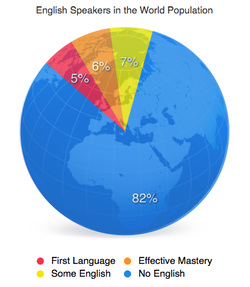
See what The Economist's Poll concluded :-)

 
 
This is a fun, though challenging, text based on H.G.Wells' classic, available in both Esperanto and English.
Depending on the age and ability of the students, it could be used for matching, sequencing or independent reading.
The Esperanto version is here and the English one here.
 
 
It is interesting to think what effect this will have on people and languages if it catches on, as seems likely. 
The way I see it, there will be two groups of people : Those who learn another language (maybe more than one other language) this way, and those who don't choose to get involved in language learning, on the grounds that having the whole internet available in their own language removes the need to invest time.
The first group will be glad that any language is now as free (financially) to learn on-line as Esperanto is now, as long as they have free access to the internet. Esperanto will still take 100 hours to master compared to 600 hours, for most European languages, and 2200 hours, for Mandarin or Japanese. And learning Esperanto first will still reduce that 2200 hours by more than 100 hours, as it does now.
The main difference, might be that both groups gain a greater awareness of the non-English-speaking world through the new availability of foreign sites in English. I think that has to be a good thing.
 
 
We'll be participating in the conference at 2pm on Monday and Tuesday, 11 pm on Wednesday and Thursday, and midnight on Friday!
 
 
Like to hear and see Esperanto in action? This little movie isn't the wordiest of stories but it is well done. It is probably available in other languages too.
 
 
Picture
To cater for a broader range of reader interests, Mondeto now hosts 3 new blogs, focussed on Children, Global Perspective and Thinking for a Better Future.
Guest bloggers are welcome if you have something to say on one of those themes :-)


Picture
The blog has been pretty quiet for a couple of days while the website has been being overhauled and expanded.
The top part of the site still gives quick answers to focused questions about Language Apprenticeship, Esperanto, Mondeto and its products.
The new bottom part of the site caters for visitors in less of a hurry who are exploring areas of interest. Under the general headings of Thinking, Global Perspective and Childhood, we are now offering a wide variety of quality links, videos, blogs (including some great guest blogs coming soon) and resources.
We hope that you enjoy the new experience and look forward to your comments and suggestions.


Picture
I just got my copy of the Spring edition of "Leadership in Focus", a quarterly professional development paper-based journal for Australasian school leaders working in schools from preparatory to year 12 level. Articles in Leadership in Focus centre on issues, trends, debates, reforms, research and developments in primary and secondary education (at the school, district, regional, national, State/Territory and international levels) that impact on schools and the work of practising school leaders.

My article,  on page 46, goes pretty much like this...

In 1996, I was the deputy principal of The Foothills School, an alternative secondary school in Perth, W.A. The school had been teaching Japanese for many years and no-one had ever actually learned Japanese as a result. We held a review to discuss whether that mattered, starting with a brainstorm of our reasons for offering LOTE at all.

Our list looked something like this:

To engage curiosity and provide a global perspective.
To build confidence and self-esteem.
To provide the cognitive advantages of bilingualism.
To encourage empathy and respect for ESL immigrants.
To give our students flexibility to learn other languages as needed later.

We also took stock of our resources, especially time. Our students had about 200 minutes a week for 3 years to spend on LOTE, ie less than 400 hours in total. We recognized that most of our goals would not be reached unless students did substantially master the target language.

We discovered that motivated adults need 2200 hours to gain basic competence in Japanese, that French or German are available in 600 hours and Esperanto could be learned in just 100 hours. (Our students were far from being “motivated adults”!)

Checking back through our goals, we asked (and answered!):

Which language would offer the best connection to the global community?

Esperanto provides a few million contacts in over a hundred maximally diverse cultures. No other LOTE offers that breadth.

Which language would best build confidence and self-esteem, even for students with language deficits?

Only Esperanto is designed to be easily learned. It is completely phonetic and uses regular word-building and uncomplicated grammar. No other language can offer as much success, to as many students.

Which language best provides the cognitive advantages of bilingualism?

In the time available, the students cannot be functionally bilingual in any other language than Esperanto.

Which language would let our students know how it feels to be limited in expression by being deprived of one’s mother tongue?

Learning another natural language would better demonstrate the difficulty of ESL but, to have the experience of speaking a second language imperfectly, students have to get further into a language than they usually do now, so Esperanto might be the best option here, too.

Which language provides most transferable experience for future flexibility?

Esperanto uses many Latin and Germanic roots so that there is a lot of transferable linguistic knowledge between English, Esperanto and other European languages. However, in its agglutinative nature and relatively free syntax, it also prepares students well for successful learning of Asian languages.

The Apprenticeship Language Effect

Studies, in Australia and abroad, have shown that a year of learning Esperanto benefits the learning of Japanese or French  even more than an extra year of studying the new target language. The usual explanation is that a year of Esperanto learning is about linguistic structures, not exceptions, so that a holistic image of the essential features of a language becomes visible, instead of being lost in the detail of random idiosyncrasies like silent letters and doubling rules.

Having concluded that Esperanto would best set students up for success, in relation to our goals, we decided that lack of a specialist teacher was not enough reason to justify a compromise. If it was worth the students time to learn, it was worth a teacher’s time so I got the job. Before I started teaching, I had 6-7 lessons in Esperanto, I collected resources (mostly old and unacceptable for modern use) and started studying LOTE methodology.

In spite of my limited preparation, the course was a great success. By the end of term 1 year 8 were staying in at lunchtime and staying hours late after school to talk to Swiss kids (who had come to school early to talk to us) in Esperanto. They didn’t have a big vocabulary at the time, but they were very keen to use what they had.

After 3 years of the program, I transferred to a Montessori primary school which was thoroughly fed up with LOTE. They felt that they had tried everything and found nothing satisfactory. I started teaching Esperanto to my class, then the next one too, and by the end of the year all of the primary school was learning Esperanto as LOTE. As with the high school students, they made good progress and soon reached the stage of being able to communicate, even though the time allowance was barely enough, at 40-60 minutes a week. In the 4th year of the program, 20 of the students travelled to Switzerland to to visit the school I had made friends with years before. The children in the two schools had no common language but Esperanto, and it served the purpose.

The last school where I taught Esperanto was a state school in rural NSW, one lesson a week (except for sports days, the first week of term and some other interruptions) to years 5 and 6 for three years. This was not enough for all students to communicate independently in Esperanto. Ten students achieved it before moving on to one of the three local high schools, where they would learn either French, Italian or German. Anecdotal evidence suggests that our students gained significant advantage from their “apprenticeship” language, Esperanto, whichever language followed.

The next year, in June 2007, the 8 major Australian Universities held a crisis meeting calling for “creative solutions” to the failure of LOTE (Languages Other Than English) education in Australia. I wondered if what I had been doing for the last decade might be such a solution.

Research revealed that the failure of LOTE was nothing new: In 1996, The Australian Languages and Literacy Council concluded that “The key finding of the council's investigation is that our education systems are consistently failing to deliver any worthwhile proficiency in languages.”

Further, in 2002, The Executive Summary of the LOTE Report, commissioned by The Federal Department of Education, Science and Training stated that:
“Given the questions and concerns that have been raised in relation to LOTE, it is appropriate to ask whether the current model of provision can ever produce better results in terms of language learning, regardless of the amount of funding injected into it.”

Primary LOTE education in Australia uses a very different model of provision than other subjects, except music. These two are commonly provided by a visiting specialist, if and when one is available.

One disadvantage of this dependence is that a suitable LOTE specialist is frequently not available. For many years there has been a worldwide, "chronic shortage of qualified language teachers, despite measures to encourage recruitment”, as the British Nuffield Inquiry Report noted in 2000.

DEST polled school principals to find out why LOTE in Australian primary schools is “consistently failing to produce results”. Where programs have failed, or have been dropped, the explanations offered can be grouped into the overlapping headings of Teacher Availability, Time, Commitment, Continuity and Consideration for the Needs of the Learner.

These problems can all be addressed by engaging some lateral thinking:

1. Teachers

Australia has no shortage of competent, qualified, primary school teachers who are fully capable of learning anything that we would expect to teach to every primary school child.

Could the creative solution, and new model of provision, be something as simple and sensible as using the professional primary educators that we already have?

My own experience shows that a generalist teacher can teach a suitable “apprenticeship language” (Lo Bianco, ACER 2010) very effectively, and it may be important that they do so - as language experts frequently cite the problem of Australia’s “monolingual mindset”. This is the idea that it is normal to be monolingual, and that only immigrants seriously speak other languages. Having normal primary school teachers demonstrate willingness and capacity to learn another language to fluency, with the children, is our best hope of changing that mindset.

As someone who has been both a classroom teacher and a LOTE specialist, I believe that the primary classroom teacher is the best professional to teach a young child a new language because s/he is the more powerful role-model of non-specialist adulthood and:

 knows the child’s abilities, maturity and motivations best,
 has effective techniques for managing the class,
 is appropriately skilled, qualified and experienced,
 is with the child all day and can provide extra time or a new task when needed,
 has the support of colleagues, administration and parents,
is already settled in the community (important in rural areas)
 has control over the classroom environment and timetable,
 can integrate language use into classroom life and other subjects.

Making LOTE education an integrated part of the generalist teacher’s work opens up opportunities for schools to raise standards in other KLA’s through use of other specialists, in science or other subjects, during weekly RFF, or DOTT, time.

Not all teachers have the opportunities I had for extensive in-service training, as a LOTE teacher and HOD, so I have spent the last two years preparing the teaching resource I wish I’d had at the outset, “Talking to the Whole Wide World”,  which contains both all a teacher needs to know about Esperanto, and a wealth of teaching strategies for use with children of various ages and stages.

The book and CD set are no more difficult to use than any other resource normally used by primary teachers. Because rules in Esperanto do not have exceptions, teachers do not have to worry that they will teach something which turns out to be wrong, as would be the case with other languages.

In the first year, the class get to share the learning adventure with the teacher, and see that everyone needs to practice, look things up, make mistakes... this is important learning. After the first year, the teacher is probably in the more usual position of being ahead of the class and is increasingly well equipped to provide “language immersion” experiences for the class.

These two strategies,  “apprenticeship languages” and “language immersion”, are recognized as winners among language teaching methodologies by Prof Joseph Lo Bianco, author of Australia’s language policy (among other things) and other experts.

Teacher supply is the reason identified by principals as the main one causing failure of LOTE programs. Fortunately, the solution proposed here also addresses the other four big reasons: Time, Continuity, Commitment and Concern for the Needs of Individual Learners

2. Time

Time issues include such aspects as:

Total time allowance
Starting time
Lesson and practice frequency
Lesson duration
Discontinuity of the program
Time on task, and
Time flexibility to allow for individual needs.

Control of most of these is constrained by dependence on specialists. Well-prepared generalists can optimize these for the character of the particular class, ensuring that language education starts at the right time, in optimally-sized blocks, integrated into the curriculum, by teachers who know their students and are able to allow extra time or extension opportunities to meet the needs of all.

The one problem which use of classroom teachers does not, in itself, resolve- is total time allowance. However, if the way that we are employing the generalists is by choosing Esperanto, then that solves the total time problem by offering a language that fits within the current time allowance available to most primary schools for LOTE.

3.Continuity

LOTE learning is strongly cumulative, so continuity is essential. Primary Esperanto education can provide continuity by reducing dependence on scarce specialists (who may leave) as well as by developing cumulative communicative competence in a single language whilst generating interest in, and understanding of, the widest variety of cultures.

Because students can reasonably expect to master Esperanto in the primary school, choosing a third language in secondary school is less anticlimactic than abandoning a partly-mastered language to start again. Whichever language(s) they choose to study later, mastery of Esperanto as a first foreign language makes the next one easier and quicker.

4. Commitment

The Primary Esperanto Strategy is fair, effective and practical enough to inspire the commitment of principals, teachers, students, parents and the wider community.

5, Sensitivity to the Needs of Learners

Best educational practice requires consideration of the characteristics of the learners, both as a group and as individuals.  Primary Esperanto is a strong strategy for the development of empathy, cognition, perspective, literacy, self-confidence and linguistic potential. It also provides maximum responsiveness to the needs of individual students by putting the LOTE program into the hands of the classroom teacher who cares for each child and knows them best.


To conclude, Esperanto may be the best choice for your primary school LOTE strategy because:

To do so models fairness, and equal respect for all cultures.
Its grammatic regularity and phonetic nature make it accessible in the time available.
Educationally disadvantaged students often gain confidence from spelling and reading success in Esperanto, even if it has been elusive in English.
Esperanto promotes English literacy, and later language learning, through transparent grammatical structure, sound/symbol constancy and use of Latin roots.
It promotes numeracy by the exact match of words and concepts to the base ten number system and other primary mathematical concepts such as fractions and multiplication.
Esperanto encourages creativity, analysis and synthesis through extensive use of regular wordbuilding.
Esperanto gives access to the widest variety of cultures in all dimensions: language, religion, arts, environment, politics, economy, resources and intercultural relationships. This broad perspective provides context for a variety of future studies.
Esperanto has no exceptions to its “rules” so students have time to learn more transferable general LOTE concepts, skills and attitudes which greatly facilitate learning other languages later.
Esperanto allows quality preparation for generalist teachers in an affordable time frame.
Classroom teachers who teach Esperanto model life-long learning and the value they put on languages.
 Classroom teachers already have the full support of colleagues, administration and communities  to make language learning as an integral part of school culture.
Primary school graduates, with experience of  successful language learning, are  best-prepared to make a meaningful commitment to the study of any third language and its culture in secondary school and beyond.


Picture
All I'm saying is simply this, that all life is interrelated, that somehow we're caught in an inescapable network of mutuality tied in a single garment of destiny. Whatever affects one directly affects all indirectly. For some strange reason, I can never be what I ought to be until you are what you ought to be. You can never be what you ought to be until I am what I ought to be. This is the interrelated structure of reality.
— Dr. Martin Luther King Jr

Our children will be the best version of themselves when they can meet other global citzens on equal terms and let them be their best too.